

Why Babies Make the O Face and Love Looking at Faces
We often find babies staring intently at our faces - but why? Read on to discover why babies are hard-wired to be fascinated with faces, and how studying facial expressions can help your baby’s development.toddWhy do babies make the O face?
That round, open-mouthed "O" usually has a simple explanation.
- Your baby is getting ready to "talk." By 4 months, most babies coo, making sounds like "oooo" and "aahh," and an "oooo" needs a round mouth. Around the same age, babies start making sounds back when you talk to them.
- Your baby is hungry. In the first months, puckering, smacking or licking the lips, bringing hands to the mouth and turning toward the breast or bottle can all be early hunger cues.
- Your baby might be copying you, though scientists still argue about this. A small 1977 study reported that babies 12 to 21 days old imitated adults' facial gestures, including mouth opening and lip pursing. A much larger 2016 study followed 106 babies from 1 to 9 weeks old and found they were just as likely to make a matching face after seeing a different gesture.
Try making an O face back, add an "oooo," and pause to give your baby a turn. By 6 months, most babies take turns making sounds with you.
Decades of scientific research shows that faces are of particular importance even to newborn babies. A few weeks later, your baby might begin to discriminate between different facial expressions. Over the course of the next several months, your baby can learn to remember and recognize people’s faces. During the first year, infants will learn to mimic facial expressions and decipher meaning based on facial expressions. Clearly, faces are an important factor in infant development.
Here are some fun facts about why babies just love faces!
-
Newborns, only several hours old, will often be observed staring at faces.
-
A newborn sees best at about 8 to 12 inches away, roughly the distance from their eyes to yours during a feeding.
-
Looking at faces can be a form of social interaction.
-
Babies can recognize faces based on head shape, chin shape, and hair length.
-
As babies grow, they learn to distinguish facial features such as the nose, lips, and eyes of another person.
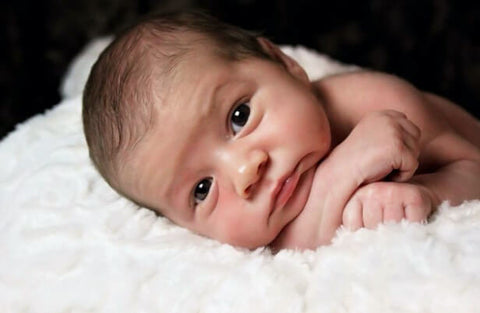
During the second half of your baby’s first year, faces also play an especially important role in your little one’s development. From about eight months on, your baby will gain vital clues about social situations based on your facial expressions. For example, crawling infants might glance at their mother’s face when confronted with a new surface - such as a slope or a step - before proceeding. Infants might behave similarly when presented with a new toy, or taken to a new location such as a museum or a local park. Babies between six and twelve months of age will often look to their caregiver’s face to determine how to act in certain situations.
Babies seem to prefer certain faces, too.
Studies show that babies prefer to look at faces with open eyes and smiles. Babies also prefer their mother’s face over the faces of strangers. Infants seem to prefer people that make eye contact with them, showing the communicative nature of our facial expressions. If you’ve ever found yourself laughing and chattering playfully with an infant sitting in a shopping cart in line at the supermarket, you now know why - the infant is delighting in one of the only forms of communication they have: eye contact!
Similarly, infants have been observed to become distressed when a caregiver no longer looks them directly in the eyes. In the typical “still-face” experiments, babies became visibly upset and stressed when the caregiver no longer made eye contact and suddenly became unresponsive. Babies need plenty of face-to-face interaction with caregivers to form solid attachment and emotional intelligence.

Faces are important for mimicry and learning to follow someone’s gaze.
Whether newborns truly copy faces is still debated (see the O face section above). What's clear is that copying grows with age. If you get excited about a new toy on the floor, your crawler may head straight over to play with it. Some kinds of copying come much later. Catching a yawn from someone else, for example, becomes much more common at around age 4.
Babies also eventually learn to follow someone’s gaze, making it easier to decipher how to act or respond in certain situations. Infants six months and older can learn to figure out someone’s intentions or learn to predict actions based on what the person is gazing at. Gaze-following can give babies important insight into what is going through a person’s mind. By the time a baby reaches one year of age, he will be able to skillfully follow a person’s gaze to figure out what that person is looking at - and maybe even guess what that person will do next based on what, and how, he is looking at the object!

If you find your baby completely fascinated with faces, don’t worry - your little one is just using facial cues to learn about the curious world around him! Help your baby learn about emotions by playing a game of making different facial expressions, and seeing if your baby imitates you! You can also make a habit of trying to make good eye contact when you interact with your baby. Faces give a lot of clues about the world!
Do remember to follow us on Instagram @keababies and join our loving and supportive KeaBabies Love Group!
Parenting is awesome. Sleep is overrated. Every day is an adventure.
|
|
Meet Our KeaMommy Contributor: Kaitlyn Torrez I’m Kaitlyn Torrez, from the San Francisco Bay Area. I live with my husband and two children, Roman and Logan. I’m a former preschool teacher, currently enjoying being a stay at home mom. I love all things writing, coffee, and chocolate. In my free time, I enjoy reading, blogging, and working out. |

Most Popular

Join the KeaCommunity
For latest updates on new products, promotions, giveaways, and more.


